Summer Term 2026
English - Writing
In English this term, Class 2 is embarking on an exciting journey through four award-winning picture books, focusing on developing descriptive language, narrative structure, and emotional expression.
Friendship and Sharing
We begin the term with 'The Yeti and the Bird' by Nadia Shireen. This heartwarming tale of an unlikely friendship allows children to explore third-person storytelling and past tense. Pupils will learn to use adverbs for sequencing and conjunctions like 'and' and 'but' to build compound sentences.
Our learning continues with the hilarious 'Pig the Pug' by Aaron Blabey. This unit focuses on character motives and feelings. Children will research animals to write their own versions of the story and develop a "How to be a..." pet guide. This sequence is particularly important for embedding phonics and Year 1 spelling requirements while exploring the importance of sharing and collaboration.
Caring and Community
After half term, we dive into the whimsical world of 'Lizzy and the Cloud' by the Fan Brothers. This unit is rich with creative vocabulary as children practice using expanded noun phrases to describe a "Cloud Seller." Pupils will experiment with command sentences to write cloud-care instructions and explore the links between weather and emotions through letters and postcards.
We conclude the year with the vibrant 'Last Stop on Market Street' by Matt de la Peña. Following CJ and his Nana on a bus journey, children will use their senses to inspire poetic language. This unit culminates in pupils writing their own narratives based on a journey to help others. It provides a wonderful opportunity to discuss diversity and gratitude, while teaching children how to write interview questions and persuasive adverts for a community soup kitchen.
Through these diverse texts, your child will develop a range of writing skills—from poetic devices to formal advice notes—while engaging with themes of kindness and community.
Computing
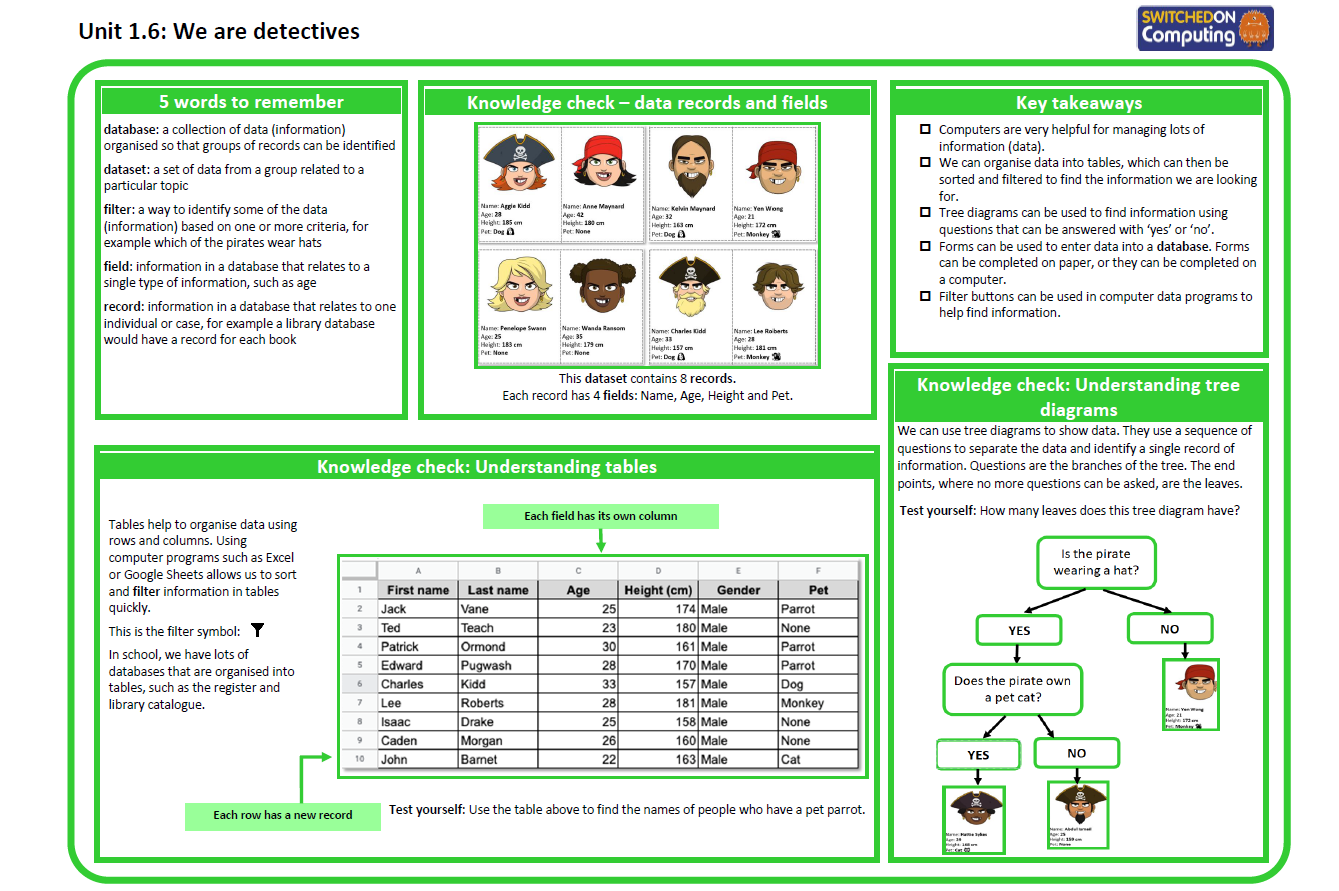
We start the new term with the unit: 'We are detectives', where pupils explore how to organise and find information using digital databases. They will learn to identify records and fields, use filters to sort through pirate-themed datasets, and use tree diagrams to solve problems. Children also develop logical thinking by using yes/no questions to navigate data and understand how forms are used to collect information. Importantly, the unit teaches how computers help us manage everyday information, from school registers to library catalogues.
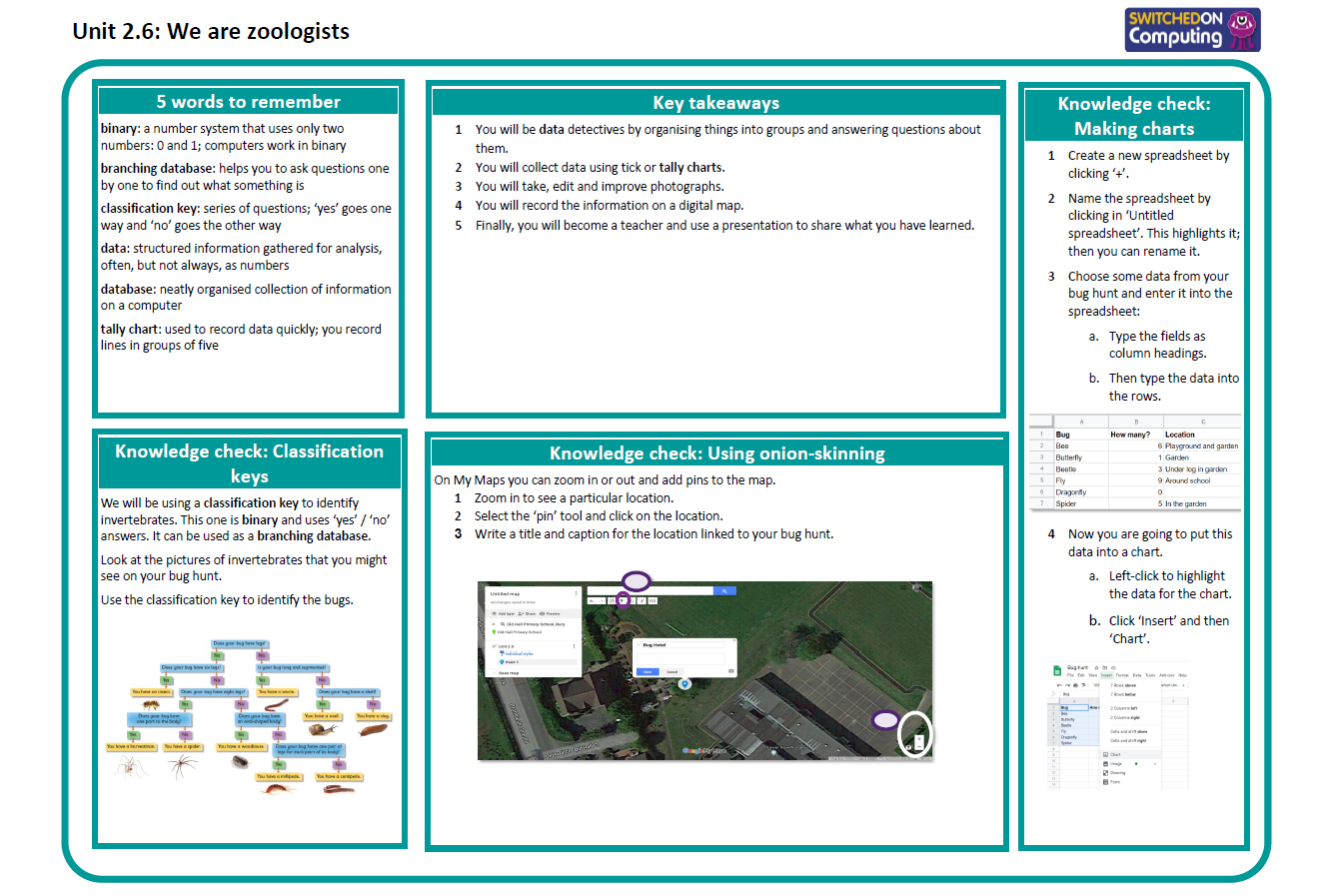
After half term we move onto the unit: 'We are zoologists', where pupils act as data detectives by collecting and organising information about local wildlife. They will learn to gather data using tally charts, take and edit high-quality photographs, and record their findings on a digital map. Children also develop analytical skills by using classification keys and branching databases to identify invertebrates through a series of 'yes' or 'no' questions. Importantly, the unit teaches how to use digital spreadsheets to create charts and how to present their scientific findings to others using presentation software.
Maths
This Summer term, we are exploring the following topics in Maths.
Money and Fractions
We begin the term with Money, where the children will develop practical life skills. As a class, we will learn to recognise all British coins and notes. We will progress to counting money in pence and pounds, before challenging ourselves to find different combinations of coins that make the same amount and calculating change.
Next, we move into Fractions. The children will explore the concept of equal parts of a whole. We will learn to identify and find halves and quarters of shapes, objects, and quantities. We will also progress to looking at thirds and three-quarters, focusing on the relationship between these different parts and how they build back up to a whole.
Time, Mass, Capacity and Temperature
Around the half-term break, our focus shifts to measurement.
-
Time: We will spend time mastering the analogue clock. The children will learn to tell the time to the hour and half-hour, before moving on to quarter past, quarter to, and eventually telling the time to the nearest five minutes.
-
Mass, Capacity and Temperature: This is a very hands-on unit where we will use various scales and measuring vessels. We will learn to measure and compare how heavy objects are (mass) and how much liquid containers can hold (capacity). We will also learn to use thermometers to read and compare temperatures.
Geometry: Position and Direction
We conclude the term with Position and Direction. The children will develop their spatial awareness and mathematical vocabulary. We will learn to describe movement and turns using terms like "left," "right," "forward," and "backward," as well as "clockwise" and "anti-clockwise." By the end of the year, the class will be confident in following and giving directions to navigate grids and solve positional puzzles.
Music
Class 2 start the term exploring an upbeat song making a real splash, with a spoken second part and rippling blue notes - The Rockpool Rock. This song and unit provide an opportunity to create an end of year ‘rockpool inspired’ performance, combining singing, playing, and dancing.
Most children will be able to:
- Learn an interlocking spoken part.
- Sing a rock ‘n’ roll-style song confidently.
- Play an introduction on tuned percussion.
- Listen actively and learn about rock ‘n’ roll music.
The Rockpool Rock Knowledge Organiser
After half term Class 2's music will be based around a welcoming Polish circle game with increasingly tricky actions, which will help to develop children’s sense of beat and encourage cooperative play. As well as learning to sing confidently in another language, children will learn to play singing games, play an accompaniment, and invent a 4-beat body percussion pattern. Additionally, they will learn about traditional dances of Poland and plan and rehearse a performance for younger children.
Most children will be able to:
- Listen and match the beat of others and recorded music, adapting speed accordingly.
- Demonstrate an internalised sense of pulse through singing games.
- Listen to traditional and composed music from Poland. Begin to understand how music helps people share tradition and culture.
- Sing confidently in Polish, and play a cumulative game with spoken call-and-response sections.
- Play an accompaniment on tuned percussion and invent a 4-beat body percussion pattern.
Phonics
Accordion content
Physical Education - PE
This Summer term, our PE sessions for Class 2 focus on building confidence, teamwork, and physical agility through a variety of outdoor activities.
Summer 1: Athletics and Skills
We begin the term by preparing for the excitement of Sports Day. All children will be practising their Athletics skills, focusing on running, jumping, and throwing. During this half term, our Year 1 pupils will be heading outdoors for Forest School, while Year 2 will work with Game On Sports Coaches to master the art of passing and receiving in team games.
Summer 2: Adventure and Coordination
After the half-term break, our focus shifts to Outdoor Adventurous Activities (OAA) and 'Run, Jump, and Throw'.
In OAA, the children will act as navigators, using map symbols and observation skills to find hidden shapes and solve clues. We will be challenging the pupils to work in pairs to guide one another—even practising how to give clear instructions to a blindfolded partner! This unit is fantastic for developing motor skills, problem-solving, and coordination using a range of unusual equipment.
Alongside this, our Run, Jump, and Throw unit will help children develop power and balance. We will be:
-
Navigating obstacle courses with speed and control.
-
Learning how to create power in our legs to turn at speed.
-
Exploring different jumping techniques for distance and choosing the best throws for various situations.
The term will culminate in team competitions where the children can apply everything they have learned, working together to compete, support their teammates, and—most importantly—have fun.
Run, Jump and Throw Knowledge Organiser
Personal, Social and Health Education - PSHE
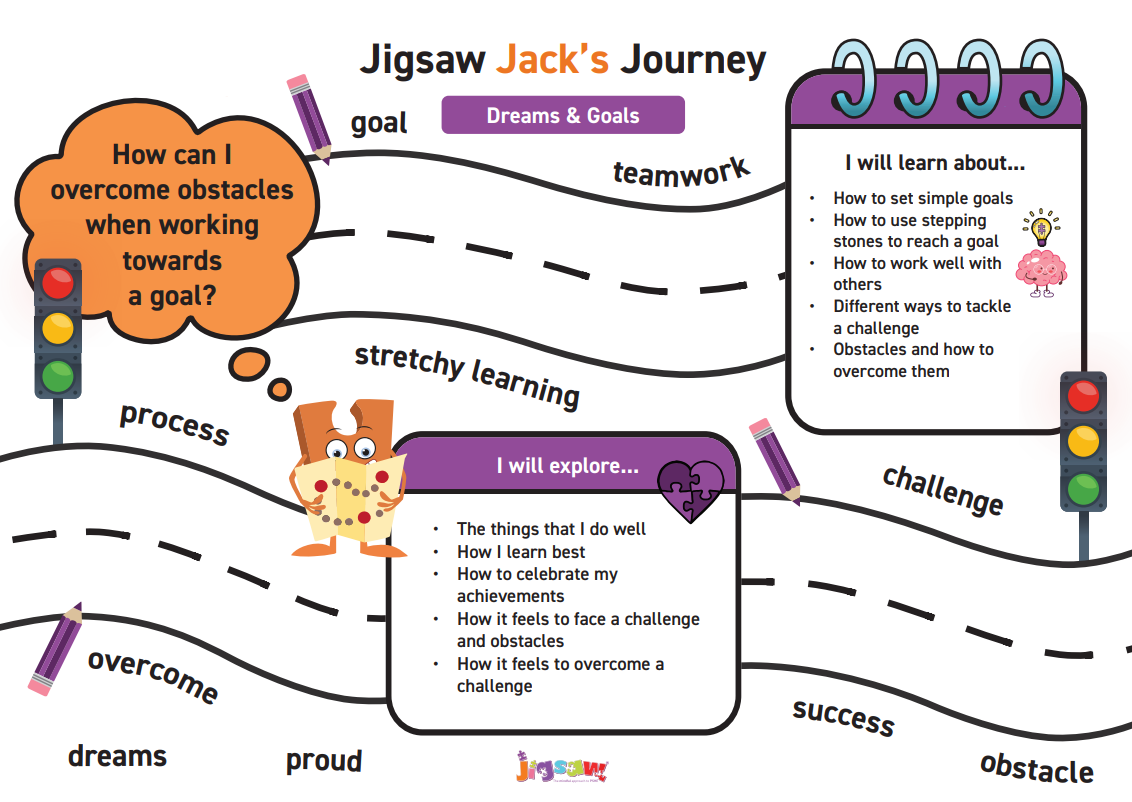
In the unit Dreams and Goals the children will learn about setting simple goals and identifying the "stepping-stones" or processes needed to achieve them. They learn to recognize their own feelings when faced with obstacles and how to overcome these difficulties through "stretchy learning". The curriculum emphasizes working well with a partner and celebrating achievements together. Children are taught to store feelings of success in an "internal treasure chest" to use when things get tough in the future. Important new concepts include team work, overcoming obstacles, and success.
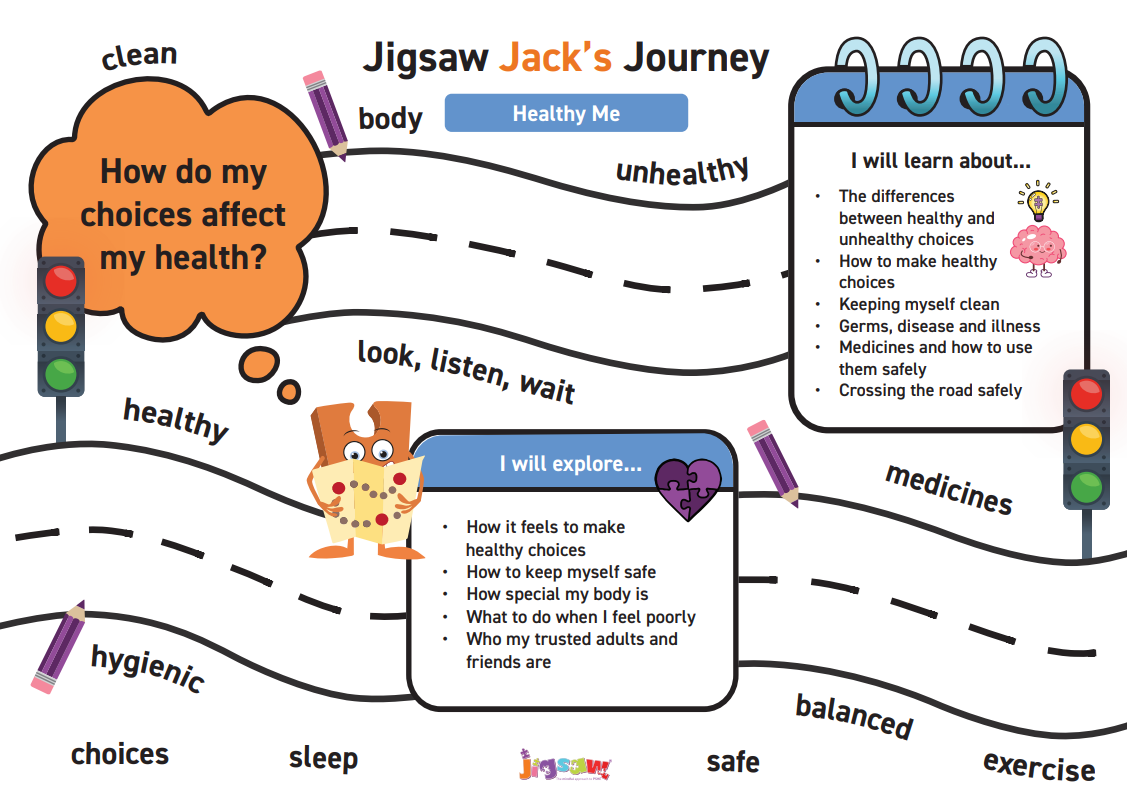
In the unit Healthy Me the children will learn about the difference between making healthy and unhealthy choices and how these decisions impact their feelings. They explore hygiene, learning that germs can cause disease and that keeping clean is essential for staying healthy. Safety is a core component, as students study the Green Cross Code for road safety and identify people in the community who can help keep them safe. The children also learn about the safe use of household products and medicines. Finally, they reflect on their own self-worth, recognizing and celebrating what makes them unique and special.
Religious Education - RE
In the first half of the Spring term the unit is "How do some Muslims show Allah is compassionate and merciful?", Class 2 will explore the core Islamic beliefs of compassion and mercy. They will learn about the Bismillah, a special phrase used by Muslims to honour Allah as the source of all existence and love. Through engaging stories of the Prophet Muhammad, such as the 'Crying Camel', children discover why it is important to treat all living creatures with kindness. The children also study how these values are lived out during Ramadan and Eid-ul-Fitr through fasting and giving to those in need.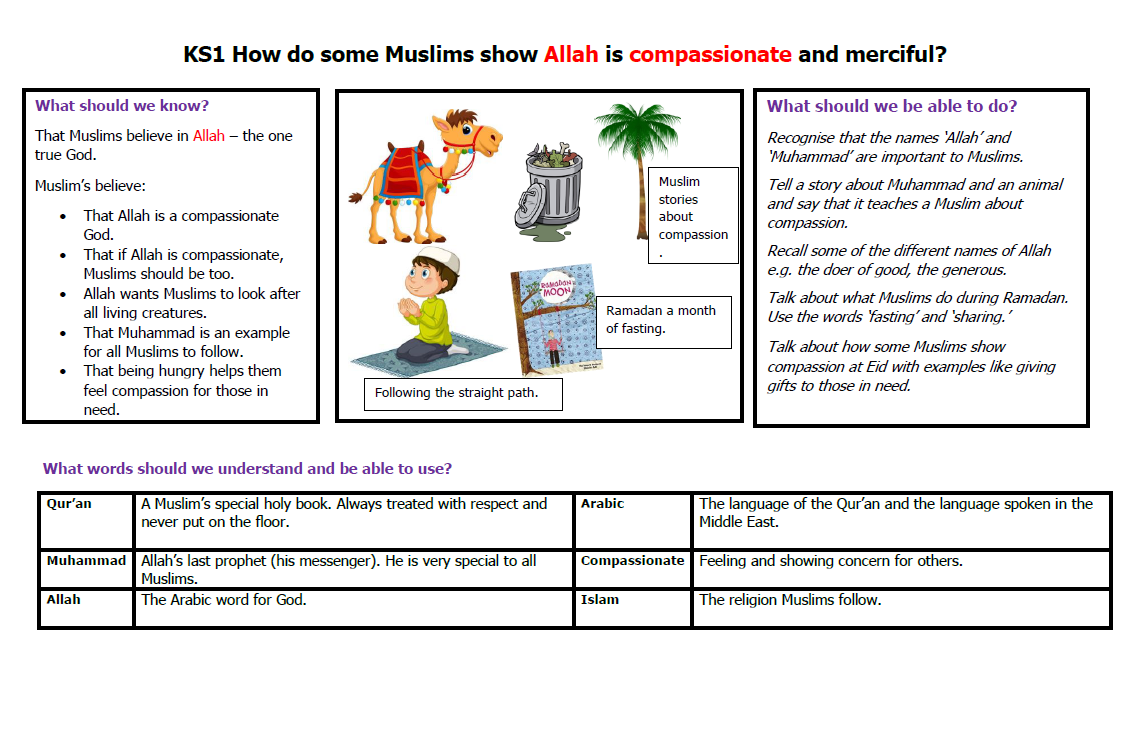
After half term, we return to Christianity. In the unit "Salvation: Why does Easter matter to Christians?", Class 2 children build on their understanding of the "Big Story" of the Bible. They explore the core Christian belief that Jesus’ death and resurrection "build a bridge" between God and humans, offering forgiveness and a fresh start. The children study the events of Holy Week in sequence—from the celebration of Palm Sunday to the reflection of Good Friday and the joy of Easter Sunday. They examine how these beliefs are expressed in church worship and discuss themes of sadness, hope, and new life through symbols like the empty tomb.